
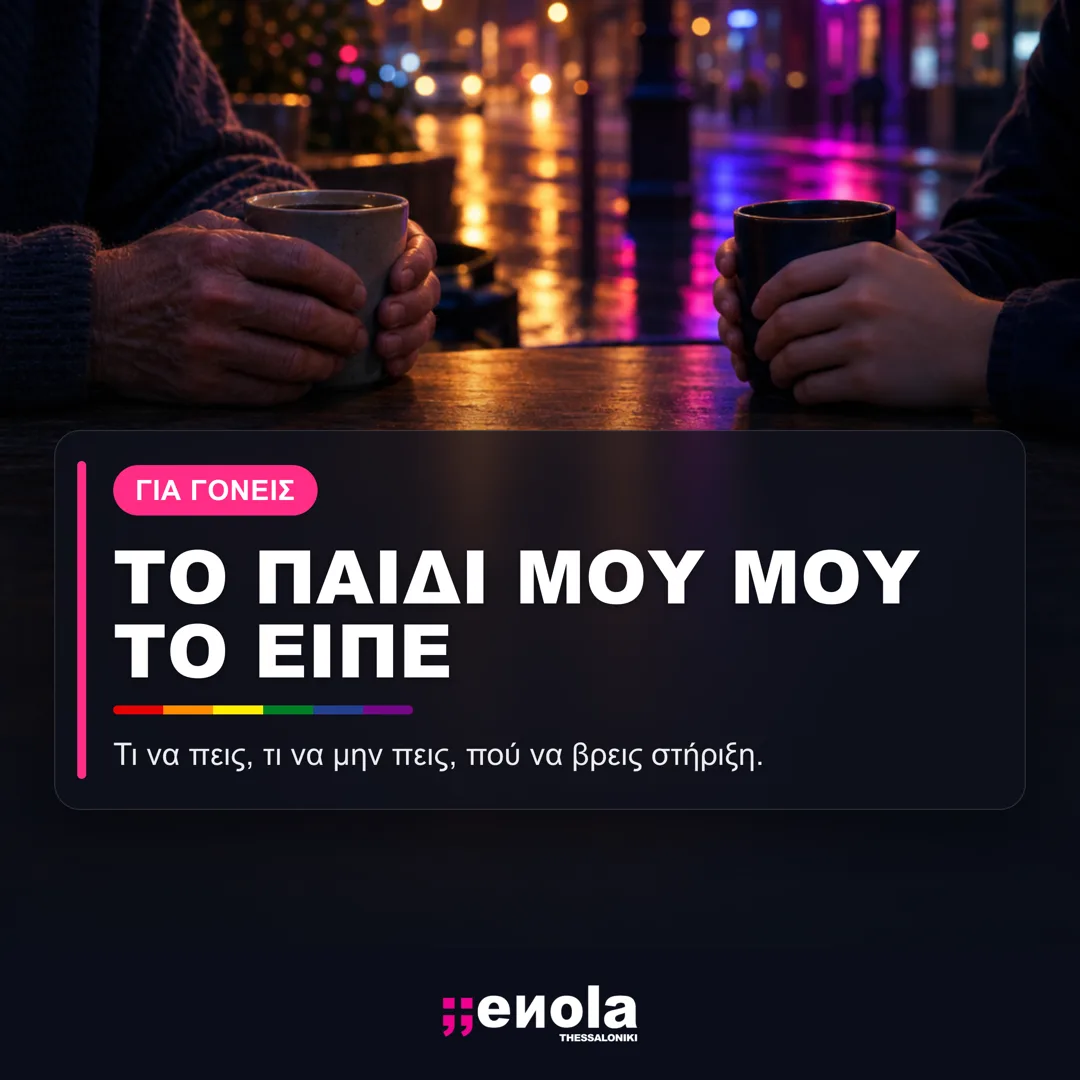
“My child told me”: a guide for parents after coming out
- Your first reaction matters: say thank you, say “I love you,” leave the door open.
- Avoid the “it’s a vibe” and the “where did I go wrong” lines.
- Don’t do outing: coming out belongs to your child.
- Share your own feelings with adults, not with the child.
- At risk: 112, 1018 (Scale), 10306.
In coming out, parents and children experience the same moment from two very different sides. Your child has gathered the courage, maybe for months or years, to tell you that they are gay, lesbian, bi, trans, or something else. You’ve just heard it. The good news: you don’t need to know all the answers. You need to show that your love hasn’t changed. This guide helps you with the first steps.
If you’re also wondering about the practical side, like what currently applies to marriage and family, we’ve written in detail about LGBTQ+ rights in Greece in 2026. Your child can have the future you dream of for them, just perhaps in a different form.
The first few minutes matter more than you think
Your child will remember your first reaction for a long time. It doesn’t need to be perfect. It needs to be warm.
What to say
- “Thank you for telling me.” It recognizes their courage.
- “I love you just as much as before.” It’s what they need to hear more than anything.
- “Do you want to tell me more?” It leaves the door open without pressure.
- “I may not understand everything yet, but I want to learn.” Honesty is okay.
What to avoid
- “It’s just a phase.” Even if you say it to reassure yourself, the child hears “I don’t believe you.”
- “What did I do wrong?” There is no wrongdoing. Sexual orientation and gender identity are not the result of upbringing.
- “Don’t tell grandpa.” Your worry about others can sound like shame.
- Questions about sex. This is not the time, and it usually isn’t your business.
Coming out parents: your own feelings
It’s natural to feel surprise, confusion, fear about how the world will treat them, even grief for a future you had imagined. You are not a bad parent for feeling these things.
What matters is where you put those feelings. Talk to your partner, a friend you trust, or a mental health professional. Don’t place them on your child: they’ve already carried enough to get here.
Many parents say their worry wasn’t so much about who their child is, but whether they would be safe and happy. That worry is understandable. The answer to it is to become the safest place in their life.
What if your first reaction wasn’t good?
It happens. Many parents shouted, cried, or said something they later regretted when their child came out. It’s not too late. Go back and simply say: “That day I didn’t react the way I would have wanted to. I love you and I want us to talk about it again.”
An honest apology from a parent can heal a lot. Don’t expect to be forgiven immediately. Show through your actions, day by day, that you mean it. Children remember both the first reaction and everything that followed.
Practical steps for the next few weeks
- Don’t out them. Coming out belongs to your child. Ask them who knows and who they want to tell, and respect the answer, even within the family.
- Learn the words. Gay, lesbian, bi, trans, non-binary: look up what they mean instead of asking your child to be your teacher in everything.
- If your child is trans or non-binary, use the name and pronouns they ask for. You will make mistakes at first. Correct yourself, say a brief “sorry,” and continue. Our guide to supporting a trans person also applies to parents.
- Look at your home with fresh eyes. Jokes at the table, comments about TV, phrases like “like a little girl.” Your child has heard all of it for years.
- Ask about school or college. Do they feel safe there? Is there bullying? If so, stand by them and speak with the school together, not on their behalf without them knowing.
- Keep normal life going. Your child is still the same person who leaves their shoes in the middle of the room and steals your fruit. Don’t let coming out become your only topic.
For more ideas, take a look at how Jo Frost inspires parents to teach acceptance. And to understand what your child is going through before they speak, read our piece on how to share your truth with your parents.
When you’re worried about their mental health
Support at home makes a huge difference for an LGBTQ+ child. But if you notice they’re withdrawing, sleeping or eating very differently, or talking about hopelessness, don’t let it pass.
- In immediate danger: call 112.
- Suicide prevention line: 1018 (Klimaka).
- Psychosocial Support Line: 10306.
For more steady support, a mental health professional with experience in LGBTQ+ issues can help both your child and you. You’ll find more in our piece on mental health in the LGBTQ+ community.
Where to find support as a parent
You are not the first parent to go through this, and you don’t have to go through it alone.
- Orlando LGBT+ (orlandolgbt.gr): an organization focused on the mental health of LGBTQ+ people. Check the current details on their site.
- Colour Youth (colouryouth.gr): an LGBTQ youth community based in Athens. Check the current details on their site.
- International resources: the Human Rights Campaign has material in English for families of LGBTQ+ people.
- Other parents: you may already know someone. A conversation with a parent who has been through it is very valuable.
And if you want to see how natural this is for so many families, read about Thessaloniki’s rainbow families. Or mark Coming Out Day on October 11 in your calendar: a good reason to tell your child again that you’re proud of them.
Try the quiz: Allyship: a mirror — a quiet look at how you stand beside your people.