
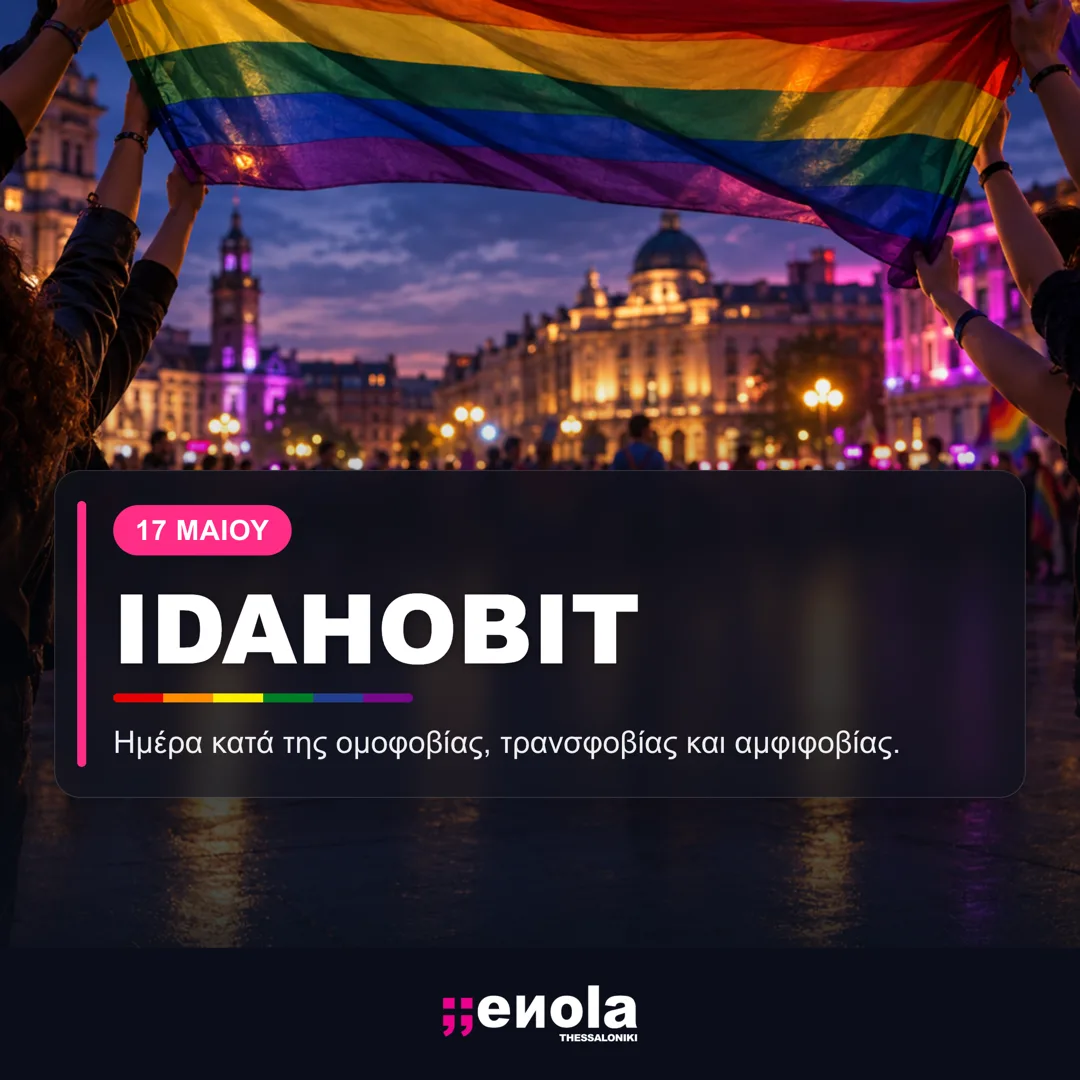
17 May: IDAHOBIT — Day Against Homophobia, Transphobia and Biphobia
- IDAHOBIT is observed every year on May 17.
- The date recalls the WHO’s 1990 decision to remove homosexuality from mental disorders.
- The day is about homophobia, transphobia, and biphobia, which still exist.
- You can take part in activities in the city, show respect for pronouns, and support queer spaces.
IDAHOBIT is the International Day Against Homophobia, Transphobia and Biphobia, and is observed every year on May 17. The date recalls the World Health Organization’s 1990 decision to remove homosexuality from the list of mental disorders. It is a day to look at how far we’ve come, how far we still have to go, and how each of us stands beside others.
IDAHOBIT is one of the brightest stops on the LGBTQ+ calendar with all the visibility, remembrance and Pride days. It falls just before Pride summer, and in a way it opens the visibility season for many cities, Thessaloniki included.
What IDAHOBIT is
The name is an acronym from English: International Day Against Homophobia, Biphobia and Transphobia. In Greek, we usually call it «Ημέρα κατά της ομοφοβίας, της τρανσφοβίας και της αμφιφοβίας». Three words, three forms of prejudice that often meet in the same life.
- Homophobia: rejection, hostility or discrimination against gay people, lesbians and generally people who love people of the same sex.
- Transphobia: rejection and discrimination against trans and non-binary people, from misgendering to exclusion from work, healthcare and public space.
- Biphobia: stereotypes and suspicion toward bi people, who are often not believed by either straight people or some queer environments.
The day is not a celebration in the classic sense. It is a reminder that equality on paper does not always mean safety on the street, at school or at the family table.
Why May 17: the 1990 decision
On May 17, 1990, the World Health Organization removed homosexuality from the list of mental disorders. Until then, at an official international level, loving someone of the same sex could be treated as a “problem” to be corrected.
That decision became a symbol. It did not erase prejudice overnight, but it changed the official framework and gave arguments to those fighting for dignity. That is why IDAHOBIT keeps this date: to remember where we started from.
Why IDAHOBIT still matters
It would be nice to say that homophobia belongs to the past. It doesn’t. Anti-LGBTQ+ rhetoric is returning in many countries, and its consequences are visible in reports of hate incidents, as we saw in our article about the link between anti-LGBTQ rhetoric and hate crimes according to GLAAD.
Last year we wrote about the power of communities and why IDAHOBIT 2025 mattered so much. The message still holds today: when public discourse hardens, the communities that support one another make the difference. Especially for trans people and young people, a day like IDAHOBIT can be the first time they hear publicly that they are not alone.
IDAHOBIT in Greece and in Thessaloniki
In Greece, important steps have been taken. Law 5089/2024 opened civil marriage and adoption to same-sex couples, and legal recognition of gender identity has been in place since 2017. But there are still gaps, which we explain simply in our guide to LGBTQ+ rights in Greece in 2026.
In Thessaloniki, visibility was built step by step. The first Thessaloniki Pride took place in 2012, and the first meeting of activists that laid its foundations happened in the winter of 2011 on the upper floor of Enola. For us, then, IDAHOBIT is not an abstract international day. It is part of the city’s history.
Enola, at Valaoritou 19, is open every day from 23:30 with a safer space policy: zero tolerance for harassment, racism, transphobia and misgendering. If something special is being prepared for IDAHOBIT, you’ll find it in Enola’s program and channels.
How to take part or stand as an ally
You don’t need a megaphone for your participation to matter. A few ideas that make a real difference:
- Find out what’s happening in the city. Organizations and collectives in Thessaloniki, as well as Thessaloniki Pride, often announce actions around May 17. Follow their channels.
- Speak up when you hear the “joke.” A calm phrase like “that’s not funny” among friends or at work does more than you think.
- Ask about and respect pronouns. The right name and the right pronouns are the simplest way to tell a trans or non-binary person “I see you.”
- Support queer spaces and artists. An evening in a queer space, a drag show, a book by a queer author: all of these keep the community alive.
- Share knowledge, not just a story. If you post something about IDAHOBIT, add a helpful fact or link, not just a rainbow.
For more about the international campaign, you can find it on the official site of the committee IDAHOBIT (may17.org).
After IDAHOBIT: May continues
May is full of visibility days. A few days after IDAHOBIT comes Harvey Milk Day on May 22 and right after that Pansexual Visibility Day on May 24. And from there, everything leads to Pride in June.
Whatever day you choose to celebrate or remember, Enola’s door is open. No dress code, with ID and 18+. Come as you are.
Try the quiz: Visibility days: how many do you know? — see how many community dates you remember.