
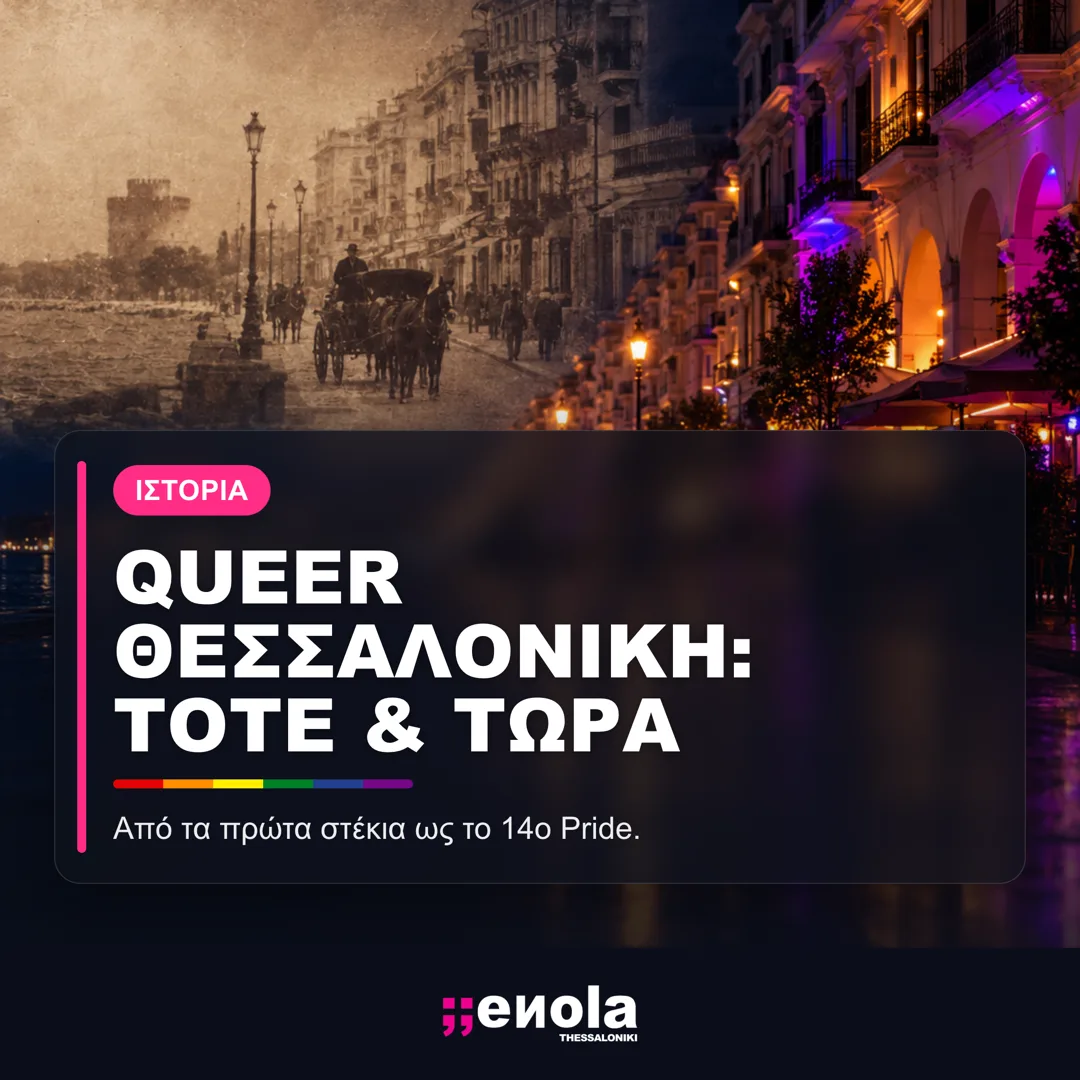
Queer Thessaloniki, then and now: from the first hangouts to the 14th Pride
- Before visibility, queer Thessaloniki lived in discreet hangouts and private circles.
- Enola opened in 2008 in Valaoritou, and in 2026 it turns 18 years old.
- In the winter of 2011, on the upper floor of Enola, the first meeting for Thessaloniki Pride took place.
- The first Pride took place in 2012; the 14th, “Break the Code,” will be held on 15–20 June 2026.
- Landmark laws: civil partnership in 2015, gender identity recognition in 2017, marriage and adoption in 2024.
queer Thessaloniki wrote its history quietly at first, and then loudly. About twenty years ago, the community was largely word of mouth, in discreet hangouts and private gatherings. Today, the city has the 14th Thessaloniki Pride, visible queer spaces, and laws that recognize couples and families. Let’s take a step-by-step look at what changed, from 2008 to 2026.
If you’re looking for what to do in the city today, our guide to queer Thessaloniki and the 10 reasons to love it is the right place to start. Here, we’re looking back to understand how we got here.
Before visibility: the first hangouts
For many years, queer life in Thessaloniki, as in all of Greece, lived mostly on the margins of public life. Without social media and without apps, you heard about the hangouts from friends, often without a sign saying what they were. Discretion was a way to stay safe, not a style choice.
Even so, people found one another. Friend groups, music, drag and the first activist voices slowly built a community. For a look at how drag and activism opened paths in Greece, read our feature on Diona Dallas, the legendary drag queen and activist.
2008: Enola opens in Valaoritou
In 2008, Enola Bar Club opened at 19 Valaoritou, on the 2nd floor, at the edge of Ladadika. It was a space that didn’t hide: queer, open, with music, drag and people coming to be themselves.
Eighteen years later, Enola remains open every night, 365 days a year, from 23:30, and describes itself as the most vibrant queer club in Thessaloniki. It hosts drag, art and music nights and supports queer artists. For all the practical details, see the official guide to Enola.
Winter 2011: the meeting upstairs
One of the most important chapters in Thessaloniki’s gay history was written in a space many people know for its nights out. In the winter of 2011, the first activist meeting that laid the foundations for Thessaloniki Pride took place on the upper floor of Enola. Among those who took the initiative was Enola’s founder, Γεώργιος Λαζαρίδης.
In 2012, the first Thessaloniki Pride took place. Since then, the city’s queer community has had its own public voice and its own celebration. You’ll find the full history and a guide for every year in the complete guide to Thessaloniki Pride, while the official news is published by Thessaloniki Pride itself.
From the first to the 14th Pride
In 2026, Thessaloniki Pride reached its 14th edition, from June 15 to 20, with the theme “Break the Code,” about breaking binary stereotypes. It was a week of workshops, screenings, discussions and music, with the parade on Saturday, June 20, along the seafront and a closing concert at the White Tower.
Read what this year’s theme “Break the Code” meant and what the parade and the after night were like. Enola has supported Pride for more than ten years, with nights during Pride Week, official after-parties and open events.
The laws that changed everyday life
The change didn’t happen only on the street. Over those same years, Greek law took three major steps:
- 2015: with Law 4356/2015, civil partnership was opened to same-sex couples too.
- 2017: Law 4491/2017 brought legal gender recognition, without requiring surgery or sterilization.
- 2024: Law 5089/2024 opened civil marriage and adoption to same-sex couples.
Gaps remain; for example, altruistic surrogacy is not open to male couples. You can find the details in our guide to LGBTQ+ rights in Greece in 2026.
Note: this is not legal advice — for your own case, speak with a lawyer. Last checked: August 28, 2026.
Gay Thessaloniki: history in progress
Thessaloniki itself has changed too. Nea Paralia became the shared strolling space of the whole city, Ladadika and Valaoritou gained a lively nightlife scene, and the metro now runs beneath Egnatia, with the “Venizelou” station just a few minutes from Enola. Students and visitors bring new people and new ideas every year.
But the biggest change is visibility. Couples who once hid can now get married. Young people find community through Pride, social media and the city’s queer spaces. That doesn’t mean the work is done: harassment and discrimination still exist. That’s why spaces with a safer space policy, like Enola, with zero tolerance for harassment, racism, transphobia and misgendering, still matter.
The timeline at a glance
- 2008: Enola opens in Valaoritou, at the edge of Ladadika.
- Winter 2011: the first meeting for Thessaloniki Pride takes place on Enola’s upper floor.
- 2012: the first Thessaloniki Pride.
- 2015: civil partnership for same-sex couples (Law 4356/2015).
- 2017: legal gender recognition (Law 4491/2017).
- 2024: marriage and adoption for same-sex couples (Law 5089/2024).
- 2026: the 14th Thessaloniki Pride, “Break the Code,” and 18 years of Enola.
If you want to go even further back, to how Pride started worldwide, read about Stonewall and the 1969 uprising.
The gay history of Thessaloniki is not a closed chapter. It is written every June on the seafront and every night on the city’s dance floors. Want to see how well you know the order of events?
Try the quiz: Put them in order — see if you remember which came first in queer history.