
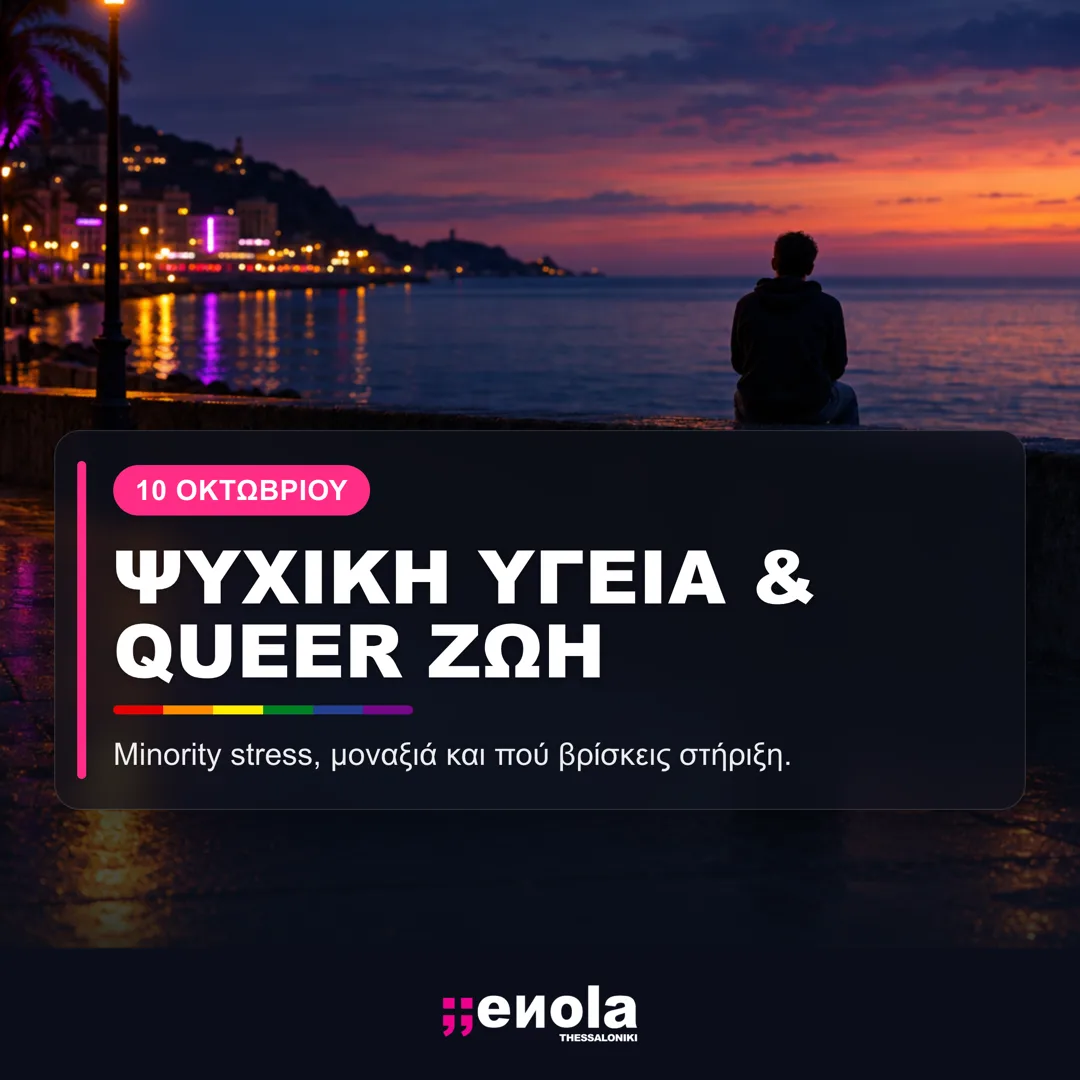
October 10, World Mental Health Day: queer mental health without taboos
- For immediate danger: 112. To talk: 1018 (Klimaka) and 10306.
- World Mental Health Day is on October 10.
- Minority stress is the extra pressure that queer people experience, not a personal failure.
- Small steps: talk to one person, find community, look for a professional who respects you.
If you are in danger right now, call 112 immediately. On October 10, World Mental Health Day, we LGBTQ+ people and our allies have every reason to speak openly about what we usually keep inside. Minority stress, loneliness, and shame are not personal failure. Below, we talk about them without taboos and tell you where you can find support, today and any day you need it.
If you need support now
- 112: for immediate danger, for you or for another person.
- 1018: the suicide intervention line of Klimaka.
- 10306: the Psychosocial Support Line, to talk with someone who listens.
You don’t need to have a “serious reason” to call. If you want a more detailed guide, read our text on where to ask for mental health support, anonymously and quickly.
World Mental Health Day: why it matters to us too
October 10 is a day to remember that mental health is health. The World Health Organization sees it as part of our overall well-being, not something to be ashamed of. In the LGBTQ+ visibility and remembrance calendar, the day falls between International Lesbian Day (8/10) and Coming Out Day (11/10), and it’s no coincidence that they fit together.
On World Mental Health Day, we LGBTQ+ people have something specific to say: much of what weighs on us doesn’t start within us, but from the way the world around us treats us.
Minority stress: the weight you can’t see
Minority stress is the extra pressure experienced by people who belong to a minority. For queer people, it can be:
- Constantly checking whether it’s safe to hold your partner’s hand.
- Having to correct your name or pronouns again and again.
- Hearing jokes that hurt you and saying nothing, so it doesn’t become a “thing.”
- Waiting for the reaction of your family, your workplace, your school.
None of this is “too much.” It’s exhausting, and the exhaustion adds up. Recognizing it doesn’t mean something is wrong with you. It means you can clearly see what you’re carrying.
The burden is not the same for everyone. Trans and non-binary people, young people who still live with their family, and those coming from smaller towns or villages often carry more. If you are in one of these positions, know that it is not your responsibility to endure everything in silence.
Loneliness and the pressure of the “perfect” queer life
Queer life has a lot of joy: friends who become family, nights you remember for years, freedom. But it also has moments of loneliness that we rarely talk about. Scrolling through profiles that seem perfect, dating apps that make you feel like a “number,” comparing bodies.
If you feel that drinking or something else has become the only way to relax, or that you go out so you won’t be left alone with your thoughts, it’s worth telling someone you trust. It’s not a judgment, it’s care. A good place to start is queer friendships that keep you going.
Mental health without taboos: small steps for today
- Say it out loud, to one person. “I haven’t been doing well lately” is enough to start.
- Find community. Colour Youth (colouryouth.gr) is an LGBTQ youth community in Athens and Orlando LGBT+ (orlandolgbt.gr) focuses on mental health. Check the current details on their site.
- Look for a professional who respects you. Ask from the start whether they have experience with LGBTQ+ people. It’s your right.
- Take care of the basics. Sleep, food, a little light, less screen time on hard days.
For more, also read our conversation about why mental health is an essential conversation for the LGBTQ+ community.
Community as a space of care
World Mental Health Day reminds us that no one gets through it alone. Spaces where you can be yourself, without watching every word, are also part of care.
At Enola, at 19 Valaoritou, a safer space policy applies with zero tolerance for harassment, racism, transphobia, and misgendering. If one night you don’t feel well or need help inside the space, talk to the Enola team. No one will judge you.
If you’re worried about a friend, you don’t need to have all the answers. Ask calmly how they are, listen without correcting, and suggest calling 1018 or 10306 together. If their life is in danger, don’t keep it secret: call 112.
And if today is one of the hard days: 112 for immediate danger, 1018 and 10306 to talk. You are not alone.
Need something right now? What do you need right now? — a few calm questions to help you figure out what would help you today, at your own pace.