
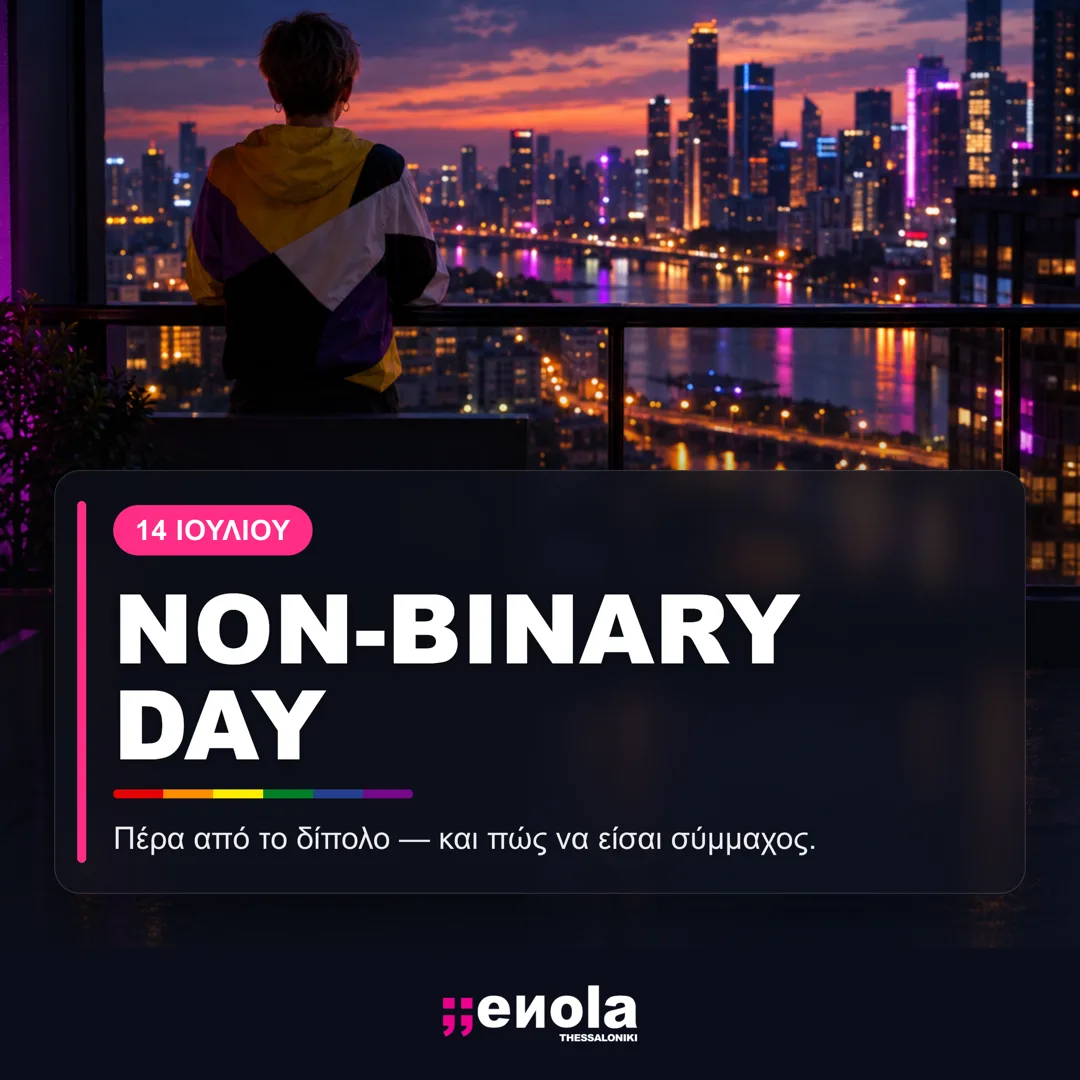
July 14: Non-Binary People's Day — beyond the binary
- International Non-Binary People's Day is observed on July 14.
- Non-binary are people whose gender identity does not fit into the male/female binary.
- In Greek, there isn’t a neutral pronoun; ask and respect the gender the person prefers.
- The non-binary flag is yellow, white, purple, and black.
Non-binary people have their own day: on July 14, International Non-Binary People's Day is observed, the International Day of Non-Binary People. Non-binary are people whose gender identity does not fit into the binary of “man or woman.” The day exists so they can be seen, so their needs can be heard, and so we all remember that gender is richer than two boxes on a form.
It is one of the summer stops in the LGBTQ+ calendar with all visibility and remembrance days, two days before International Drag Day on July 16.
What non-binary means
Gender identity is the inner sense of who you are. For many people it matches “man” or “woman.” For non-binary people, not quite or not at all.
Non-binary is an umbrella term. Under it, different experiences fit:
- Genderfluid: people whose sense of gender shifts over time.
- Agender: people who do not feel they have a gender. They also have their own day, Agender Pride Day on May 19.
- People “in between” or “both”: those who feel they combine elements of more than one gender.
And an important point: being non-binary has nothing to do with how you dress or how you look. There is no “non-binary look.” There are non-binary people, with every style in the world.
The non-binary flag
The non-binary flag has four horizontal stripes: yellow, white, purple, and black. You’ll see it at Pride parades, on pins, and in bios, often alongside the trans flag.
Non-binary in Greek: language and pronouns
Greek is a language with strong grammatical gender: almost every adjective, participle, and article “signals” gender. This makes everyday life a little more complex for non-binary people. There is no single established neutral pronoun, so each person finds their own solution.
- Some people prefer a specific grammatical gender.
- Some alternate between masculine and feminine.
- Some prefer wording that avoids gender, e.g. “the person,” or simply their name.
The rule is simple: ask and respect it. A “how would you like me to address you?” solves most things. If you make a mistake, correct it and move on, without a big apology that puts the other person in an awkward spot. You can find more in our article about International Pronouns Day.
Three myths about non-binary people
- “It’s a new trend.” The word non-binary has been heard more often in recent years, but people who didn’t fit the binary have always existed. They just now have the vocabulary to say it.
- “They just want attention.” Most people would prefer less attention: not to be stared at, not to have to explain themselves. Saying who you are is a matter of dignity, not showing off.
- “All non-binary people are trans” or “none of them are.” Some non-binary people identify as trans too, others do not. Again, the answer belongs to the person themselves.
Why the day matters, and in Thessaloniki too
Non-binary people often face a daily, quiet exhaustion: forms with only two options, “Mr.” and “Ms.” at every counter, questions like “yes, but what are you really?” Visibility does not solve everything, but it makes that exhaustion a little lighter.
In Thessaloniki, Thessaloniki Pride 2026 had the theme “Break the Code,” about breaking binary stereotypes. It’s hard to find a better starting point for talking about non-binary identity. Read what it means in our article about “Break the Code” and this year’s Pride theme.
At Enola, at 19 Valaoritou, the safer space policy means zero tolerance for transphobia and misgendering. If something isn’t right inside, talk to the Enola team. No dress code, 18+ with ID, every day from 23:30. Come as you are, literally.
How to be an ally to non-binary people
- Believe what they tell you. Someone’s identity does not need your approval or explanation.
- Respect name and gender, even when the person is not around.
- Watch the “good morning ladies and gentlemen.” A “good evening everyone” or “good evening, folks” says a lot.
- If you’re making forms or questionnaires, think about whether you really need gender and, if so, add more options.
- Learn from the material that already exists. Our guide with 10 tips for supporting a trans friend applies largely to non-binary friends too. For a European framework, see ILGA-Europe.
Visibility for non-binary people doesn’t have to be limited to one day. It is also connected to Trans Day of Visibility on March 31, but above all to the way we speak to one another every day.
Try the quiz: Visibility days: how many do you know? — from Non-Binary Day to Ace Week, how many do you remember?